This portfolio is password protected. Enter the password to continue.
Incorrect password. Please try again.
Amazon Alexa · 2023
Overview
Timeline
Design 3 weeks May 2023 - Ongoing
My role
Lead designer User researcher
Scope
Conversational AI Interaction design System architecture integration
Team
Alexa experiences
Tools
Figma Figjam
Solution
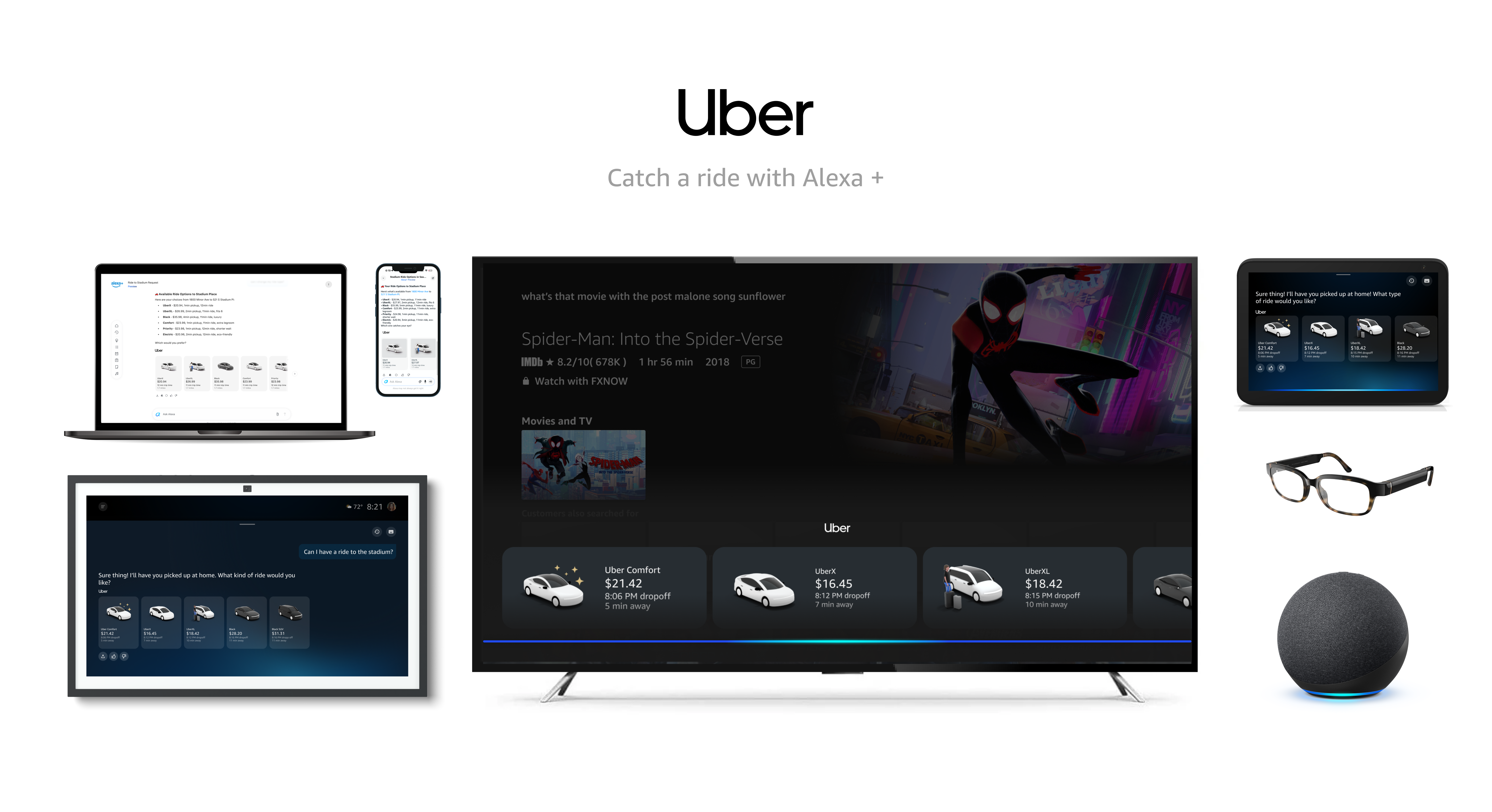
Using the Uber use case, I designed a template for rideshare on Alexa+, a new voice-forward commerce experience built on large language model (LLM) capabilities, so it could understand natural language across both voice and touch. I also integrated legacy API structures and structured the designs to work with MCPs to deliver personalized ride experiences based on context and user history.
With Uber on Alexa+, users can call a ride in less than 10 seconds, and more quickly request transportation, integrate personal context into ride booking, and complete a booking across voice and touch without starting over.
A smarter Uber experience
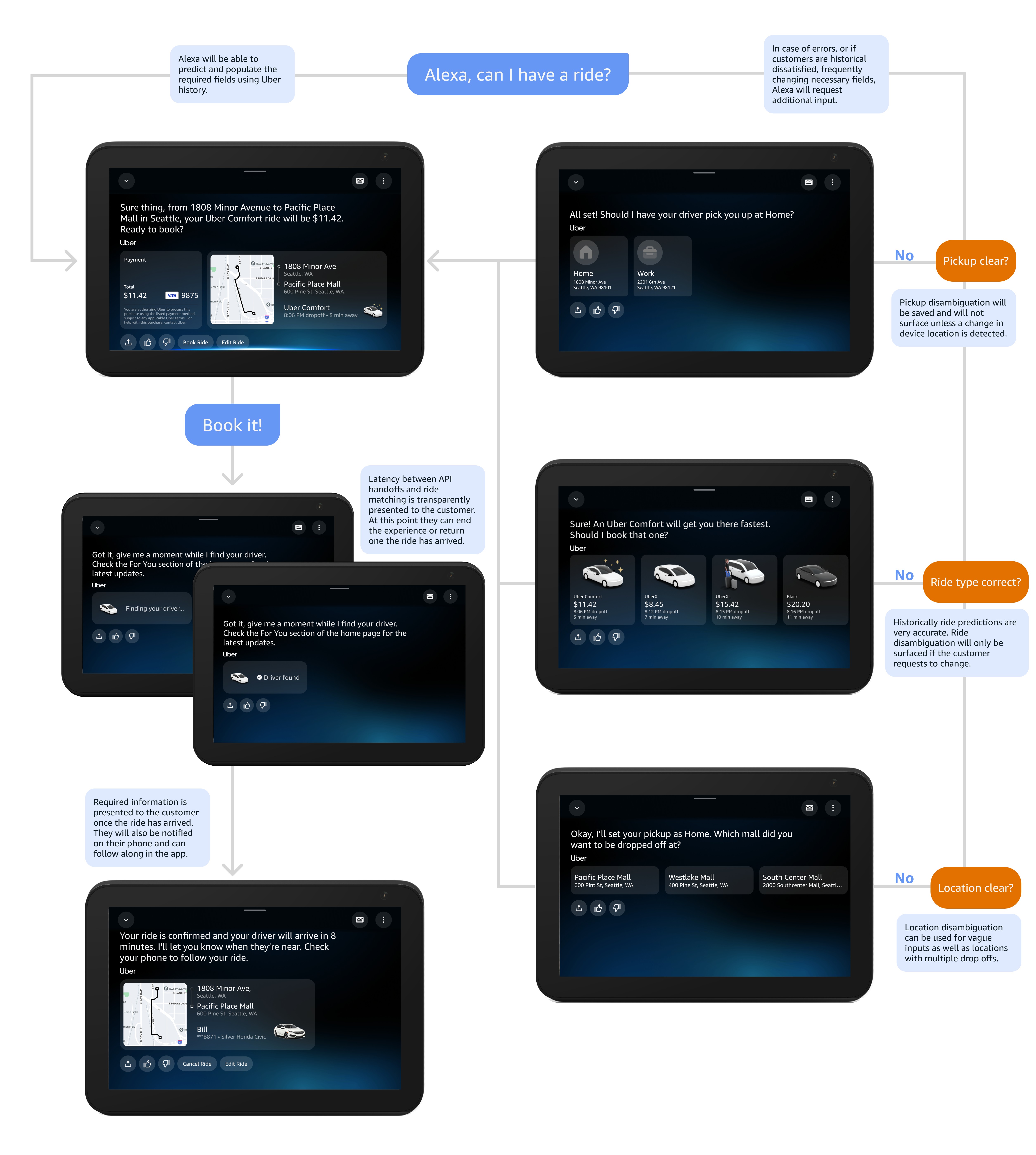
Based on previous consumer patterns and approximate geographic location, Alexa is able to accurately predict fields such as pickup, dropoff, and preferred ride type without needing to clarify.
Impact
Designed the first purchasing experience for Alexa+, one of the earliest transactional voice-commerce flows of its kind. It grew to become the #1 most-used third-party capability on Alexa+, driving 30 million+ invocations, and set the interaction patterns other teams now build on for voice-based commerce. Tooling to track the metrics defined above, like pickup accuracy and time-to-book, is still being put in place, so usage volume and adoption rank are the numbers available today.
The legacy Uber experience was designed for deliberate, touch-first mobile interaction. When translated to ambient multimodal surfaces, this high-touch approach forces users into a linear flow, exposing three core friction points:
High Interaction Cost
A baseline ride request requires a minimum of 4 manual taps, jumping to 8-12 sequential taps whenever users need to make adjustments.
Contextual Inflexibility
Existing voice skills rely on rigid slot-filling models that enforce linear navigation and fail to handle real-world conversational turns or mid-stream repairs.
Visual Load
Users must maintain head-down visual focus on a smartphone screen for 30-60 seconds, directly conflicting with low-effort, voice-forward experiences.
Research and Testing
Objective
Multimodal Handoff & Interaction Continuity
Figure out how someone hands off between voice and touch mid-flow without it feeling like a hard reset.
Find the right balance between asking a clarifying question and quietly assuming the most likely answer when a voice command is ambiguous.
Post-Booking Expectations
Work out how to handle live ride status and driver updates through a voice assistant once booking is done and the user's attention has moved on.
Methodology and Approach
To shape the design direction for Uber on Alexa+, we used Rapid Iterative Testing and Evaluation (RITE) combined with Wizard-of-Oz prototyping, which let us watch how people actually behaved and iterate on the interface quickly instead of waiting on a full research cycle.
Participants & Setup
Participant screening: Participants had to own and regularly use a smart display, and have real rideshare experience, so their instincts about how these apps work would be realistic, not guessed.
Approach: Prototyped task simulation with organic voice and touch interaction patterns by preparing various responses to the different things testing participants might say.
Session Protocol
Baseline Profiling: Assessed smart device ownership, daily AI tool usage, and historical rideshare habits.
Wizard-of-Oz Simulation: Guided participants through scenario-based prototype flows, capturing natural voice intents and instances where they instinctively wanted to touch the screen.
Debrief & Iterate: Gathered qualitative feedback on cognitive load, trust in AI-driven recommendations for ride details.
Key Findings and Behavioral Insights
Predictive Intent, Confirmed at Booking
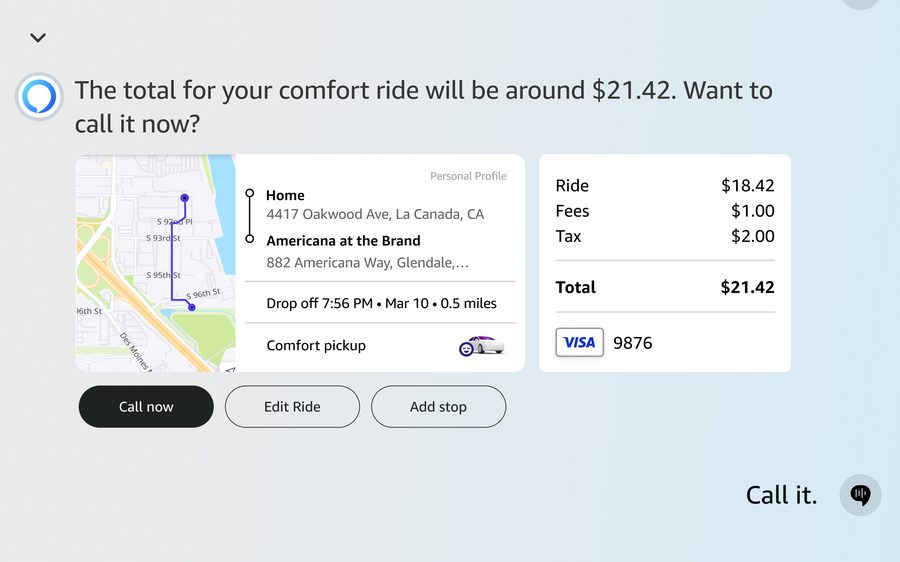
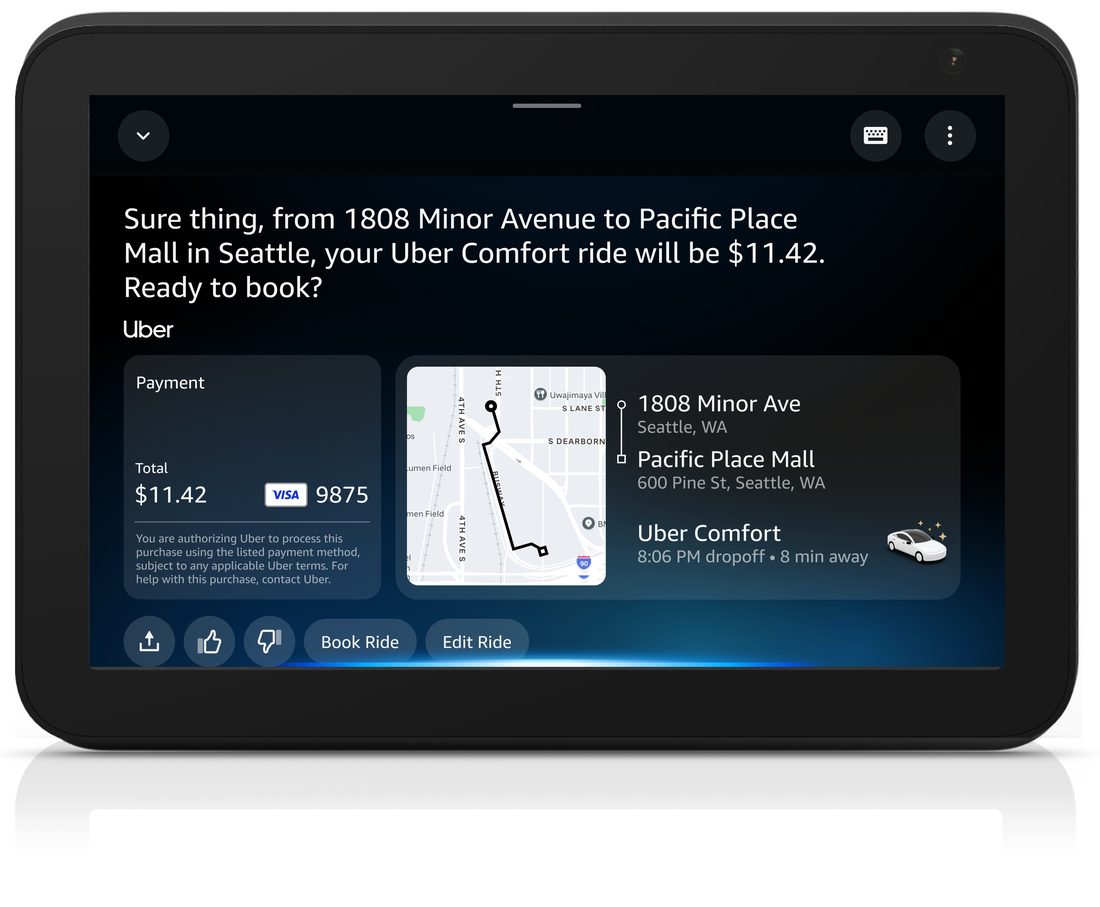
A command like "take me to the mall" is broad enough that we could infer it from someone's location and past trips. Rather than stopping to ask a separate clarifying question, Alexa assumes the most likely match and folds the confirmation into the last step before booking. We also renamed "Call now" to "Book Ride," since the original label undersold that this was a financial commitment, not just a tap.
Critical Alerts and Edge Cases Belong on the Mobile Phone
Testing made this one obvious: a driver arriving while someone's already outside doesn't matter much if the alert is sitting on a smart display in another room. People expect that kind of time-sensitive update to reach them wherever they actually are for the post booking experience. Which means the follow up interaction should be sent to their phones.
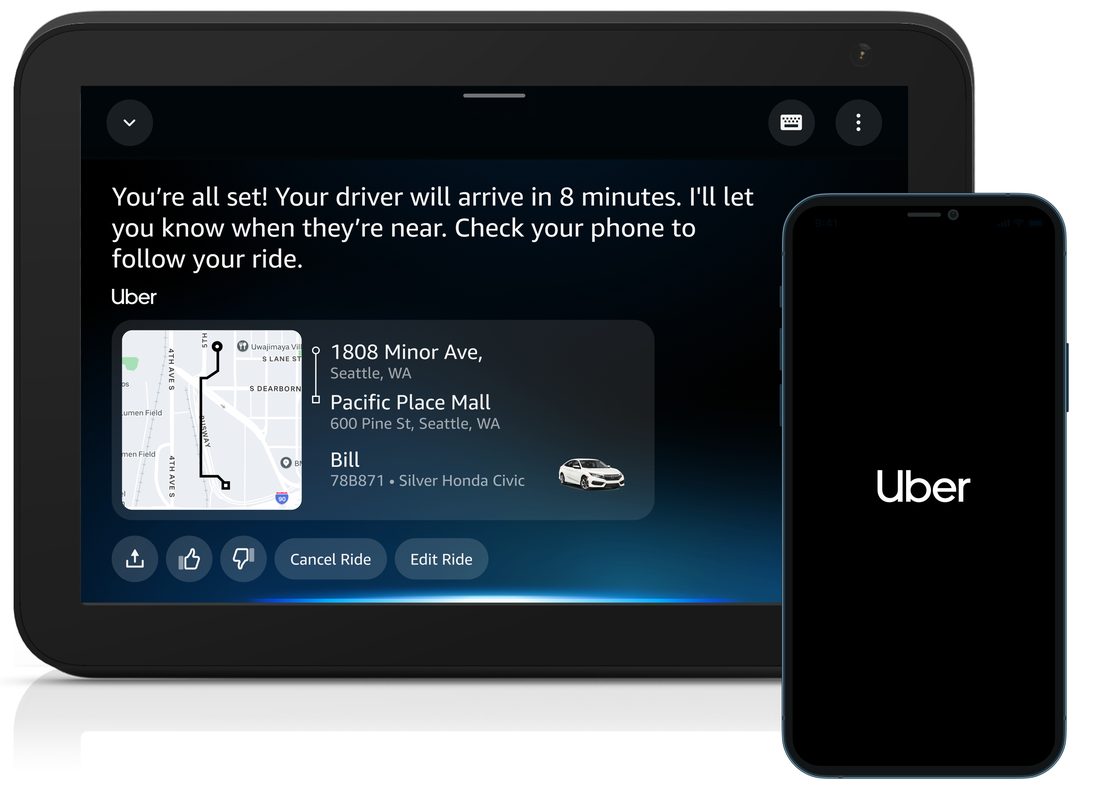
Once a ride is booked, people mentally check out of the screen and go back to their day. So the moment that matters most is what they see right before they walk away: the car, the plate, where it's headed. Showing safety anchors like vehicle photos and license plates clearly, alongside the drop-off details, is what let people leave the display without second-guessing the booking.
Design Process
Cross-Org Collaboration
Shipping a first-of-its-kind multimodal experience meant syncing up closely across a wide network of internal teams and high-stakes external partners.
Internal Cross-Functional Partnership
Product Management: Partnered with PMs to turn early design explorations into solid product requirements, while also mapping out what the next phase of the experience would look like.
Engineering and Solutions Architects: Worked hand-in-hand with engineering to build within legacy API limits and existing tech stacks, adjusting designs smoothly as technical needs shifted.
Design Systems: Teamed up with core design systems teams to build out the new pattern libraries and visual components required for ambient smart displays.
Legal: Handled regulatory compliance, platform policies, and third-party contract requirements side-by-side with legal and bizdev teams.
Business Development: Put together multiple pitch decks and demoed early concept explorations to help secure partner buy-in, inform contracts, and drive ecosystem growth.
Marketing: Crafted visual assets and promotional scripts to support launch campaigns and go-to-market efforts.
Quality Assurance Engineers: In addition to conducting testing myself, I partnered directly with the QA team to build out detailed test case outlines that would allow comprehensive testing of the experience.
External Collaboration with Uber
Executive Alignment: Ran weekly syncs with Uber VPs, product leads, and design counterparts to iterate on product direction and align on feature scope.
Ecosystem Integration & Handoff: Worked directly with external engineering and design partners to make sure the handoff for live ride tracking and third-party ecosystem integration held up on both ends.
Legacy Architecture Audit
I conducted a deep UX audit of legacy graphical ride-sharing applications (Uber, Lyft, Waymo, Bolt, DiDi Rider, and more), supplementing it with third-party research to understand the established mental models and interactions.
Key findings
GUI Mental Model Pattern
Legacy Mobile Behavior
Ambient Voice / Multimodal Translation
Impact / Benefit
Simultaneous Evaluation
Comparing 4–5 tiers (Standard, Comfort, Premium, XL) & surge prices in under 3 seconds.
Progressive Disclosure: Defaults to top preferred tier; mentions alternatives on request.
Eliminates 15 sec of audio listing; protects short-term working memory.
Implicit Confirmation
Dragging a map pin or tapping "Confirm" provides silent visual feedback.
Verbal Confirmation Loops: Proactively verifies edge-case or non-standard pickup points.
Prevents wrong-side-of-street driver arrivals and missed pickups.
Passive Monitoring
Glancing at live map polylines and moving car icons every minute.
Milestone Turn-Taking: Mutes minor updates; speaks only at critical delivery thresholds.
Removes ambient room noise while maintaining user trust.
Key Decisions
01
Contextual Pickup Resolution
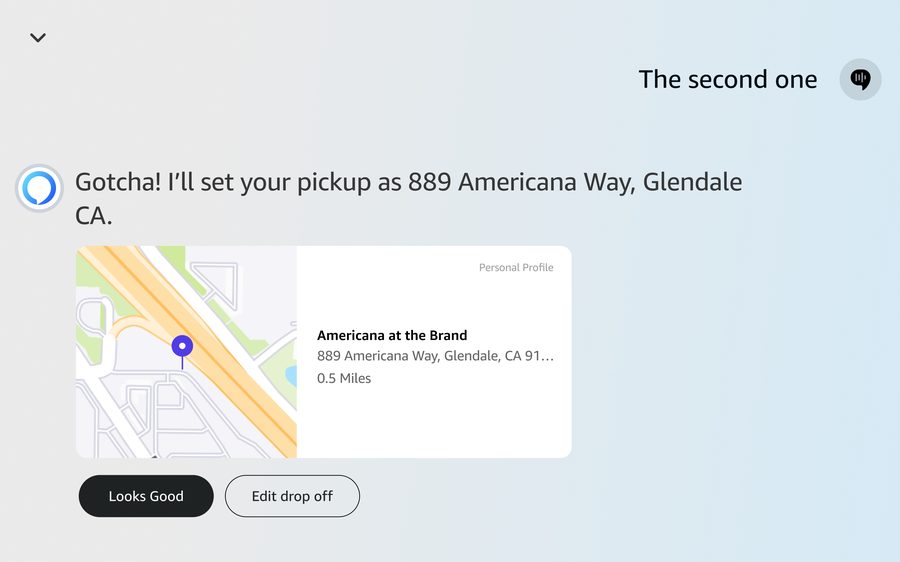
Uses real-time device location to validate historical address data, automatically inferring the primary pickup address from the user's account when no pickup point is specified.
Pros
Skips a clarification step entirely by predicting the pickup point the moment location details are left out.
Allows general locations to be mapped to locations relevant to the user (e.g. Home, Work, School).
Cons
Users can reflexively say "yes" without really checking the prediction, which risks a misrouted dispatch at a complex or multi-entrance venue.
02
Cross-Device Continuity & App Handoff
Transfers active voice sessions from ambient smart devices to the mobile app to handle visual, high-friction tasks (e.g. route edits, error cases) and live vehicle tracking. Preserves session state via deep links, allowing users to move fluidly between voice and screen without re-entering booking details. Mobile is used as a fallback, not a default. Most Echo devices are stationary, so handing off to the phone is what lets someone keep tracking their ride after they've left the room.
Pros
Starts hands-free on voice, then lets the user visually double-check complex trip details without losing their place.
Sends dense information, like maps, to handheld devices that make heavy touch interactions more fluid.
Cons
If it triggers too early or for something trivial, suggesting a phone interaction mid-flow breaks the hands-free promise the whole experience is built on and could potentially add an extra turn.
03
Asynchronous Driver Matching & Ambient Status Tracking
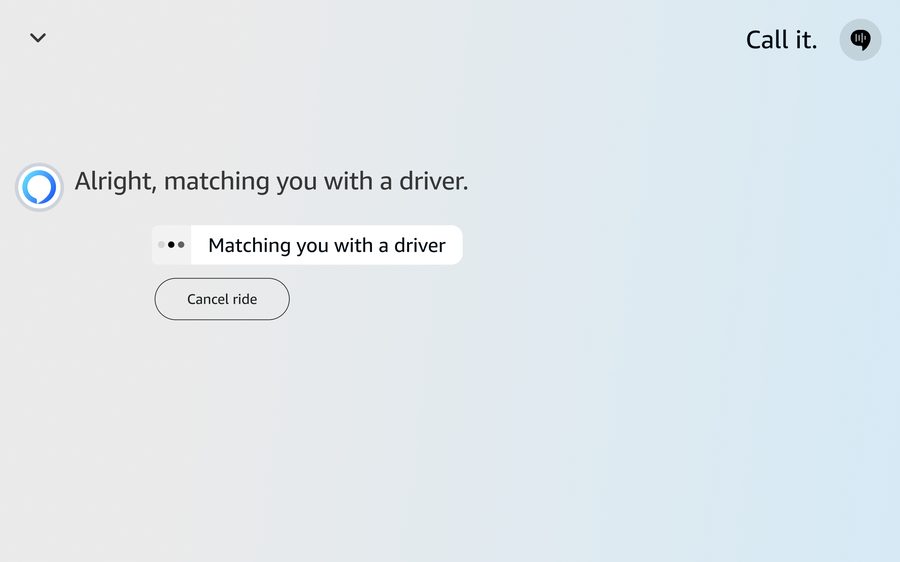
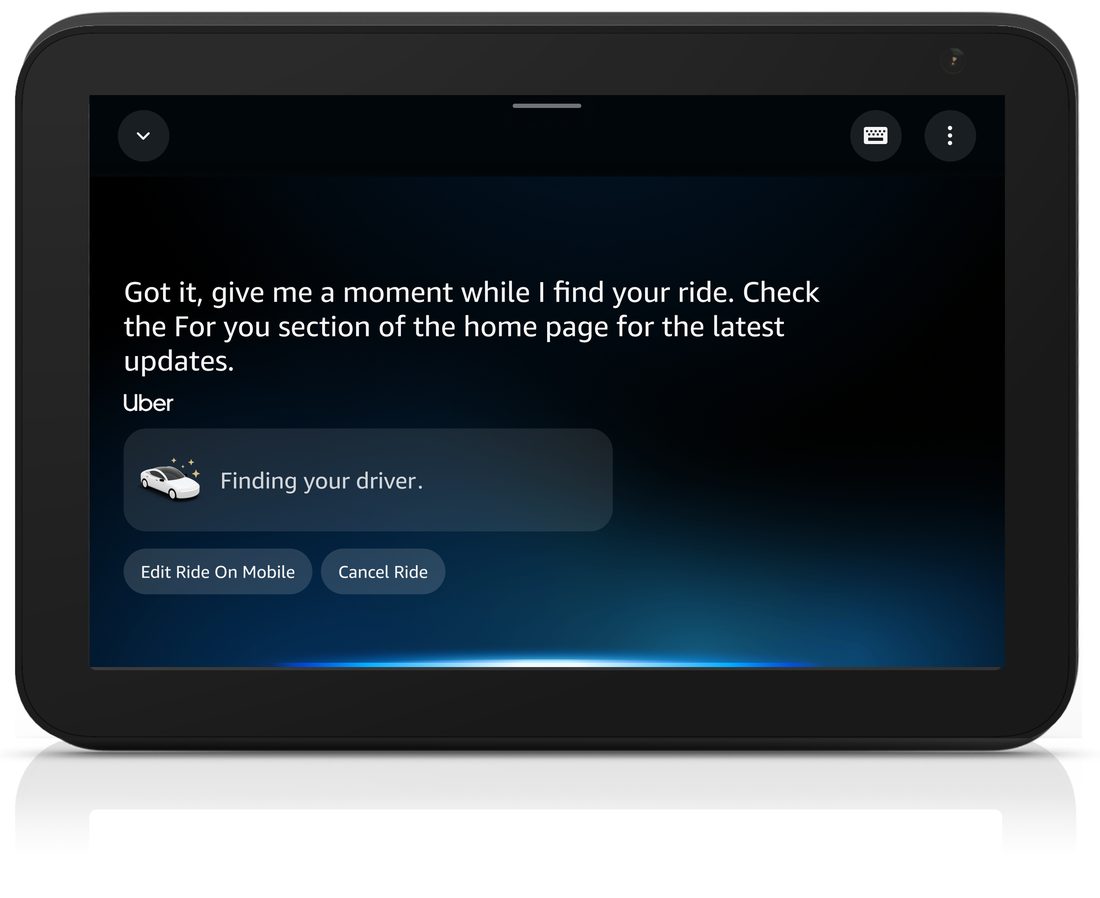
Enables users to step away from the device immediately after requesting a ride, decoupling the driver-matching waiting period from active voice engagement.
Pros
Users are free to move around, grab a coat, pack a bag, instead of standing still waiting on continuous verbal updates.
No waiting around:Cuts out the unnecessary wait and repetitive polling phrases ("Still searching for a driver...") by ending the conversational session right after a ride is booked.
Cons
If users want more than 3 notifications, it requires them to ask for the status of a ride or check the screen once they have stepped away.
Rationale: Validates that explicit verbal confirmation loops eliminated location ambiguity at complex venues, preventing real-world drop-offs without introducing conversational friction.
Task Completion Speed & Dialog Efficiency
Metric:Time-to-Book & Single-Turn Intent Retention (including Field Edit Friction)
Rationale: Demonstrates that smart defaults streamlined the core booking path, while progressive disclosure ensured overriding pre-filled fields remained effortless rather than triggering dialog abandonment.
Final Design
Core Customer Experience
Promotional Campaigns
Chris Hemsworth Alexa+ Super Bowl Commercial(0:00)
Pete Davidson Books a Ride with the All-New Alexa+(0:02)
Meet the New Alexa(0:19)
Next Steps
Design Vision & Platform Evolution: These concepts depend on future API enhancements and cross-service data hooks, but together they outline a roadmap for evolving Alexa+ from a booking tool into a proactive travel assistant.
Deepen integrations with personal calendar systems such as flight itineraries and out-of-office events to anticipate transportation needs automatically.
Convert upcoming flights or scheduled dinner reservations into ready-to-confirm ride suggestions, so the experience starts anticipating trips instead of just responding to requests.
Train the underlying LLM agent on recurring user routines (such as weekly Friday night commutes or recurring weekend gym trips) to refine location and tier prediction accuracy over time.
Evolve pre-filled fields from static account defaults into dynamic, time-aware predictions that remove address entry friction altogether.
Dynamic Price Tracking & Incentive Optimization
Introduce conversational price monitoring and automatic promotional or discount application directly within the voice dialogue.
Notify users when surge pricing drops or a preferred tier qualifies for a promotion ("Surge pricing just ended for Comfort. Would you like me to book now for $22?"), so the savings are surfaced instead of left for the user to notice on their own.
Traffic-Aware Predictive Departure Alerting
Synthesize real-time traffic telemetry, route conditions, and target arrival times to calculate optimal departure windows.
Expand the assistant's role into ambient time management ("Traffic is building on the freeway. To reach your 7:00 PM reservation on time, I recommend requesting a ride in 10 minutes.").
Current Status
Uber on Alexa+ is live. I'm still refining the experience and fixing issues as they come up, and new features are actively being scoped. This user experience has also been extended to , bringing Alexa+ to 100% of the US rideshare market: 76% Uber, 24% Lyft.
 , bringing Alexa+ to 100% of the US rideshare market: 76% Uber, 24% Lyft.